

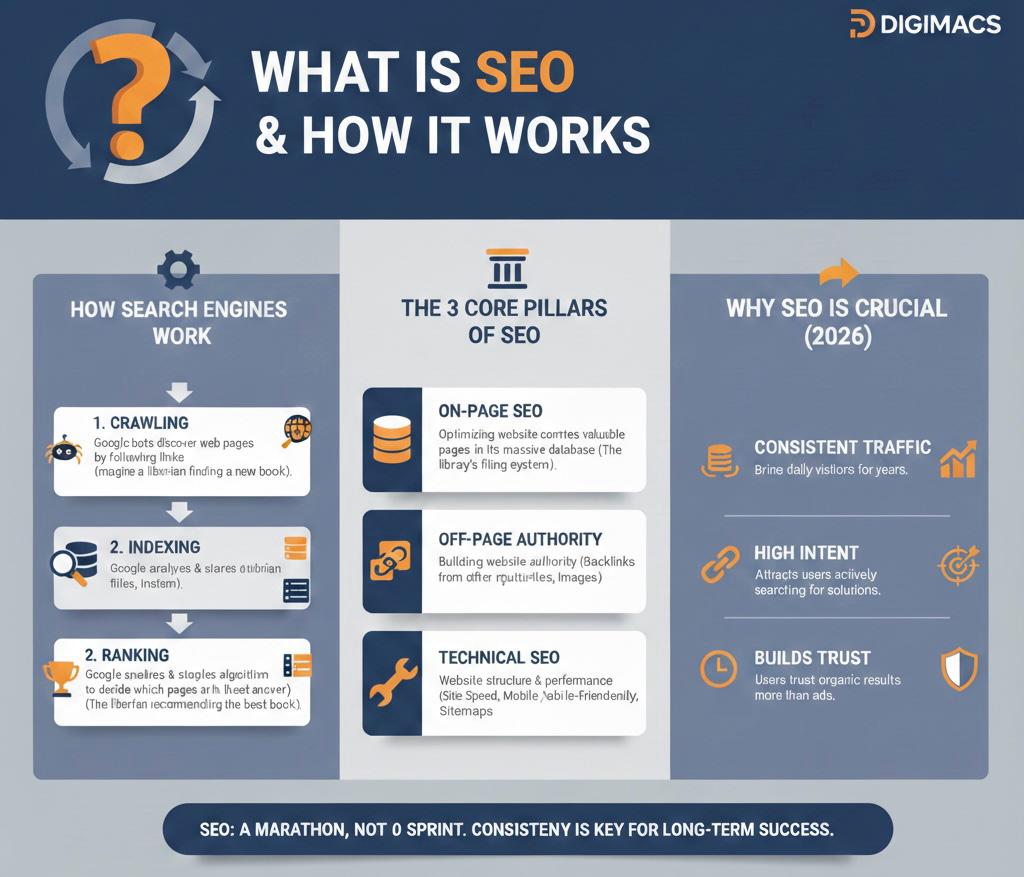
What is SEO and How Does It Work? Beginner’s Guide in 2026

Imagine you have opened the most beautiful shop in the world, but you built it in the middle of a desert where no one can find it. Will you make any sales? Probably not. The same happens to websites without SEO. You might have great content, but if Google doesn’t know you exist, your audience will never find you. If you read our previous guide on What is Digital Marketing?, you know that there are many ways to promote a business online. But among all those strategies, SEO is the most powerful long-term investment you can make.
📑 Table of Contents
•What is SEO (Search Engine Optimization)?
•How Do Search Engines Actually Work?
•Step 1: Crawling (The Discovery)
•Step 2: Indexing (The Filing System)
•Step 3: Ranking (The Decision)
•The Three Core Pillars of SEO
•1. On-Page SEO (Content)
•2. Off-Page SEO (Authority)
•3. Technical SEO (Foundation)
•Why is SEO Crucial for Your Success in 2026?
•Conclusion: SEO is a Marathon, Not a Sprint
•Frequently Asked Questions (FAQs)
In this guide by Digimacs, we will break down exactly what is SEO and how it works in simple, plain English, so you can start ranking your website in 2026.
What is SEO? (Search Engine Optimization)
SEO stands for Search Engine Optimization. In the simplest terms, it is the process of improving your website so that it appears higher in search engine results pages (SERPs) like Google, Bing, or Yahoo when people search for topics related to your business.
The goal of SEO is to attract “organic” traffic. Organic means FREE traffic. You are not paying for ads; you are “earning” your spot at the top by proving to Google that your content is the best answer to a user’s question.
* If you pay to be at the top, that’s SEM (Search Engine Marketing) or Google Ads.
* If you rank naturally because your content is good, that’s SEO.
How Do Search Engines Actually Work?
To master SEO, you need to think like a search engine. Google’s main goal is to provide the most relevant and high-quality answer to a user’s query as fast as possible.
But how does Google know every webpage on the internet? It uses a three-step process: Crawling, Indexing, and Ranking.
Let’s imagine the internet is a giant library, and Google is the head librarian.
Step 1: Crawling (The Discovery)
Before Google can rank your site, it needs to know it exists. Google uses automated software programs called “crawlers,” “spiders,” or “bots.”
These bots constantly browse the internet, moving from one link to another. When you publish a new post on Digimacs and link it to an older post, the Google bot follows that link and discovers your new content. This is why internal linking is so important!
Step 2: Indexing (The Filing System)
Once a bot discovers a page, it tries to understand what the page is about. It analyzes the text, images, and video files.
If Google determines that the content is valuable and unique, it stores that page in its massive database. This database is called the “Index.” Being indexed means your page is now in the library and can potentially be shown to users.
(Note: As we discussed previously, sometimes Google crawls a page but decides not to index it if it thinks the page is low quality or duplicate.)
Step 3: Ranking (The Decision)
This is the final step. When a user types a query into the search bar (e.g., “best digital marketing guide”), Google digs through its Index to find all relevant pages.
It then uses a complex algorithm (with hundreds of ranking factors) to decide which page should appear at position #1, #2, and so on. The most relevant and authoritative pages get the top spots.
The Three Core Pillars of SEO
Knowing what is SEO and how it works is great, but how do you actually do it? SEO is generally divided into three main categories:
1. On-Page SEO (Content)
This relates to the content on your website. It includes strategies to ensure search engines understand a page’s topic.
* Keyword Research: Finding what your audience is searching for.
* Quality Content: Writing in-depth, helpful articles that solve problems.
* Title Tags & Meta Descriptions: Writing catchy headlines for Google search results.
* Image Optimization: Using descriptive file names and ALT text for images.
2. Off-Page SEO (Authority)
This happens outside of your website. It tells Google that other people trust your site. The biggest factor here is Backlinks. A backlink is when another reputable website links to your content. Google sees these links as “votes of confidence.”
3. Technical SEO (Foundation)
This involves the backend structure of your site. It ensures that Google bots can crawl and index your site without any issues.
* Site Speed: Your website must load fast on mobile devices.
* Mobile-Friendliness: Your site must look good on phones.
* Sitemaps: Providing Google with a map of your site structure.
Why is SEO Crucial for Your Success in 2026?
You might be thinking, “Why not just use social media?” While social media is great, SEO offers unique benefits:
* Consistent Traffic: A social media post dies in 24 hours. A well-ranked SEO article can bring you traffic every single day for years.
* High Intent: People searching on Google are actively looking for a solution. They are more likely to become customers than someone mindlessly scrolling through Instagram.
* It Builds Trust: Users trust the organic results on the first page of Google more than paid ads.
At Digimacs, our mission is to help you master these skills so you don’t just rely on paid ads, but build a sustainable online asset.
Conclusion:
SEO is a Marathon, Not a Sprint.
SEO is not a “get rich quick” scheme. You cannot trick Google in 2026. It takes time, consistency, and high-quality effort to see results. But once you start ranking, the rewards are immense.
Now that you understand the basics of how SEO works, the next step is knowing what your audience is actually searching for. Stay tuned for our upcoming guides on Keyword Research!
Is it possible to do SEO by myself?
Yes, absolutely. The basics of SEO can be learned and implemented by anyone with a website. You don’t need to hire expensive agencies when you are just starting. Guides like the ones on Digimacs are designed for DIY beginners.
How long does it take for SEO to work?
SEO is a long-term strategy. Generally, it takes 3 to 6 months to start seeing significant movement in rankings and traffic, especially for a brand-new website. Consistency is key.
Is SEO free?
The traffic you get from SEO is free (organic). However, doing SEO requires an investment of time to create content, or money if you hire tools or writers to help you.